Watching the Bees Do Their Work
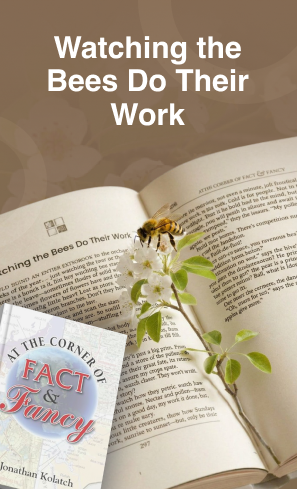

It is pollination time in apple and pear orchards around the world. The white and pink blossoms have opened, and growers can be seen standing at the edge of their fields with a mixture of hope and worry. If the bees do not do their work now, there will be no fruit come harvest in the fall. No apples hanging heavy on the boughs, no pears ripening in the crates, no reward for months of pruning, spraying, and anticipation.
The chapter “Watching the Bees Do Their Work” in Jonathan Kolatch’s charming At the Corner of Fact & Fancy captures this remarkable annual drama with warmth, humor, and admiration. It reminds us that while farmers may cultivate the land, there is yet another workforce in the orchard—the tiny, the tireless, and the winged–-whose efforts make fruit possible.
The Blooming Orchard
There are few sights more beautiful than an orchard in bloom. Rows of apple and pear trees burst into clouds of white and pink. What only days earlier looked like bare wood suddenly becomes alive with promise.
However, the beauty of apple and pear blossoms is short-lived. Their petals are open for only a short time; then they fade and fall to the ground. During that brief timespan, pollination must occur. Pollen from one flower must be transferred to another so that the process of fruit formation can begin.
That is precisely why what occurs in orchards in spring is so crucial to the size of the harvest in the fall. With the trees ready, the flowers waiting, and farmers having done everything in their power to create favorable conditions, it is the bees that the season now depends on.
Kolatch describes looking across the meadow and seeing blocks of white, pink, and rose blossoms. At first glance, the trees appear still and silent. Yet, hidden among the flowers, there is intense activity. The bees have already begun their work.
Where Did All the Bees Go?
Initially, Kolatch observes, it can be difficult to spot the bees at all. They seem to be invisible among the fuzzy new leaves and the bare branches. Then, suddenly, once you know where to look, they are everywhere.
They dart from tree to tree, from branch to branch, from blossom to blossom, moving so quickly that the eye struggles to follow them. Their size makes the task at hand seem unachievable. How can such tiny creatures be so critical to the success of the orchard? Yet they are.
A single worker bee visits innumerable blossoms in a day. As it gathers nectar and pollen, grains of pollen cling to its body and are carried to the next flower. With each landing and take-off, pollination occurs.
There are no roaring machines, no grand gestures, but in these repeated acts of nature lie the beginning of every apple and pear that will fill the markets and ultimately our kitchens.
The Trade and the Terms
“Watching the Bees Do Their Work” presents pollination as a kind of bargain between farmer and bee. The blossoms provide nectar and pollen. The bees transport these riches to the hive. In return, the bees distribute pollen to the pear and apple flowers. And thus fruit development begins. A truly remarkable agricultural partnership.
Kolatch humorously notes that the bees work “only on their terms.” They are not machines, and their activity depends heavily on weather conditions.
During the cold winter months, bees are less active. If the temperatures don’t warm up and spring mornings are chilly, pollination is slow and less effective.
Rain keeps the bees away from the orchard; instead, they take shelter. Wet wings and cold bodies make flying a difficult task.
Bees can bear some wind, but strong gusts make it difficult for them to navigate and even land on the flowers. Windy weather equals poor pollination.
Conversely, warmth and sunshine lead to an increase in bee activity. An orchard on a sunny day hums with activity.
Dealing with the Competition
“Watching Bees Do Their Work” imagines the insects evaluating flowers based on the nectar rewards. The pear may be noble, but the dandelion provides greater returns. This playful comparison points to an ecological truth: bees choose their sources strategically.
Not all flowers provide the same nectar quantity and accessibility. If more attractive blooms are nearby, the bees’ attention will be divided. Needless to say, fruit growers want the pollinators to focus on their trees, not on surrounding vegetation. And so, managing the orchard floor by eliminating competing growth through mowing or other means is essential. Bees are, after all, very practical. They go where rewards are the greatest.
A Final Note
“Watching the Bees Do Their Work” in At the Corner of Fact & Fancy, published by Jonathan David Publishers, reminds us to actually value that which can be easily missed. In a world that celebrates finished products, Jonathan Kolatch invites us to honor beginnings.