Shavuot–A Celebration With Special Significance
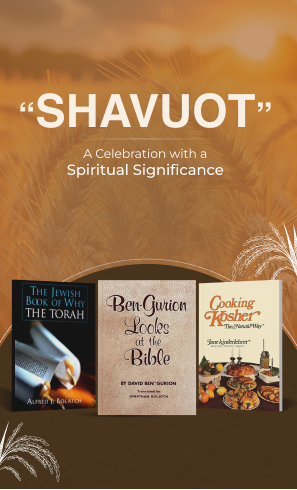

For Jews worldwide, one of the most important celebratory events in the calendar is the festival of Shavuot.
Shavuot marks a defining moment in Jewish history–namely, the giving of the Torah to the Jewish people. Literally meaning “teaching,” the Torah is comprised of the first five books of the Hebrew Bible. This remarkable document has been the moral and spiritual foundation of Jewish life for more than 3,500 years.
According to tradition, the Torah was revealed to Moses on Mount Sinai seven weeks after the festival of Passover, which commemorates the liberation of the Jewish people from enslavement in Egypt.
Learn More About the Torah and Its Relationship to the Shavuot Festival
To learn about the origin of the holiday of Shavuot (literally, “weeks”), to learn about how it is related to the receiving of the Torah on Mount Sinai, you need look no further than The Jewish Book of Why: The Torah. Written by Rabbi Alfred J. Kolatch in crystal-clear, straightforward language, this authoritative volume addresses hundreds of questions about the Torah scroll and how it has become the centerpiece of Jewish life.
To maintain the sanctity of the Torah, many laws and customs have been introduced. Answers to why these laws and customs have become an integral part of Jewish tradition and how they have been incorporated into Jewish practice are readily available in The Jewish Book of Why: The Torah.
- Why was Mount Sinai chosen as the site of the Revelation?
- Why should a Torah scroll be written on parchment with a quill?
- Why are non-Jews not permitted to handle a Torah scroll?
Following an accessible “why” format, Rabbi Kolatch answers these and hundreds more questions about the Torah rites and rituals practiced in the synagogue today. The Jewish Book of Why: The Torah will deepen your insight into the significance of the sacred document.
Deepen Your Understanding With Ben Gurion Looks at the Bible
The rich content of the Torah has been the subject of much debate and interpretation. During his tenure as first Prime Minister of the State of Israel, David Ben-Gurion convened what he called the “Prime Minister’s Bible Study Circle.” Its stated purpose was to analyze the complex moral and theological issues explored in the Old Testament.
Ben Gurion Looks at the Bible, originally published in Hebrew in 1969 and later translated into English by writer Jonathan Kolatch, features the brilliant addresses presented by the Prime Minister to the select students in his Bible Study Circle. Anyone interested in the sacred text will find the analysis and conclusions of one of Israel’s most important historical figures both fascinating and stimulating.
Discover Shavuot Specialties in Cooking Kosher the Natural Way
No celebration is complete without an extensive array of food. The special dishes of Jewish cuisine have been handed down through generations, and the delicacies enjoyed on Shavuot are no exception. Stemming from the phrase “honey and milk under thy lips” (Song of Songs 4:11), on Shavuot it is customary to serve both dairy foods and honey. These words from Song of Songs suggest that the words of the Torah energize our spirits as honey and milk do our bodies. Cheesecake, cheese blintzes, cheese quiche–any dish featuring cheese as a major ingredient–-all are enjoyed as part of the holiday meals.
In her Cooking Kosher the Natural Way, Jane Kinderlehrer, former editor of Prevention magazine and a pioneer in the health foods movement, presents recipes for dishes that are both nutritious and delicious. There is no reason, she maintains, that we can’t enjoy tasty holiday treats without compromising our health. On Shavuot, try her luscious yet easy-to-prepare Pineapple Cheesecake.
Pineapple Cheesecake
It is always gratifying to enjoy a delicious cheesecake without your conscience nagging you. While dietary concerns frequently take a back seat during festivities, it is always better to choose recipes that provide wholesome nutrients in every palate-pleasing bite. Try this nutritious yet delicious cheesecake recipe from Jane Kinderlehrer’s Cooking Kosher the Natural Way.
For the Crust:
1 cup whole wheat pastry flour
- ¼ cup softened butter
- 1 tablespoon vegetable oil
- 1 beaten egg
- 2 tablespoons sour cream or yogurt
- 2 tablespoons honey
- 1 tablespoon baking powder
- A pinch of salt
Preheat the ovento 350 degrees F. In a bowl, mix together the flour, butter, and oil. Then add the egg and the remaining ingredients. Mix well, then roll out the dough and line the bottom and sides of an ungreased 10-inch spring-form pan. Bake in the preheated oven for 10 minutes. Remove from the oven and let cool.
For the Filling:
- 1 pound cottage cheese
- 1 can (20 ounces) unsweetened crushed pineapple, drained
- 4 beaten egg yolks
- ¼ cup honey
- A dash of cinnamon
- 4 egg whites
- A pinch of cream of tartar
- 2 tablespoons honey
Mix the cottage cheese, pineapple, egg yolks, honey, and cinnamon; blend well. Spread the mixture over the crust. Bake for 15 minutes in a preheated 400-degree F. oven. While the cake bakes, make a meringue by beating the 4 egg whites with the pinch of cream of tartar until stiff. Then, gradually add the two tablespoons of honey. Remove the cake from the oven, then spread the meringue on top. Return to the oven and bake for approximately 15 minutes, until golden brown. Serves 8 to 10.
Final Thoughts
The major festival of Shavuot encourages engagement with the teachings of the Torah, the text of which has been studied, debated, and interpreted by scholars across generations. For a clear understanding of the holiday and its significance, refer to The Jewish Book of Why: The Torah, by Rabbi Alfred J. Kolatch. For analysis of the Torah text itself, seek out Ben-Gurion Looks at the Bible, which has been translated from the original Hebrew by Jonathan Kolatch. For delicious holiday recipes, leisurely leaf through Jane Kinderlehrer’s Cooking Kosher the Natural Way.